Wednesday, 07:02
Your virtualX answered 62 clients last night.
Nothing went out that you hadn't approved. Three things need you.
It was supposed to help your clients get unstuck when the question can't wait for you.
It's 9:40pm and your client is stuck on step four of your framework. Nothing dramatically, just stuck enough that she can't do the next thing without an answer. And frustrating enough that it will sit in her head all evening if she doesn't get one.
Because it takes two minutes and she's a good client, even though it's the same question you've answered thirty times this year, and your workday ended three hours ago.
Somewhere between typing and hitting send, a small voice asks what happens on the nights it's not you who sees the message.
She pastes the page she's stuck on and your framework into ChatGPT or Claude, whichever tab is already open. Her robot answers in four seconds, sounds completely sure of itself, and gets it mostly right. Mostly.
Two weeks later, on your group call, you're listening to advice you never gave, wearing your name.
The question gets answered tonight either way.
The only question left is: by what?
It was never about replacing you. Your clients only wanted your answer before morning.
Clients will ask AI. The question is what stands between your expertise and the answer they receive.
Another chatbot trained on your content doesn't solve the real problem. What matters is having a controlled place for your expertise to meet the question. That's what virtualX is.
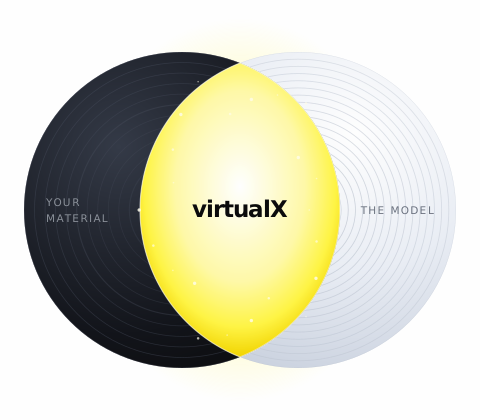
Your material goes in. Your decisions shape what comes out. Your clients get an answer when you're not there.
And when the answer shouldn't come from AI, it stops.
Every reply is built from an entry you read and said yes to, phrased your way, with the source shown under the reply. Your client can check it. So can you.
When a question needs the real you, she gets the polite refusal you wrote yourself. The question is on your desk before you're awake. And you can address it live on your next call, record an entire workshop around it, or simply send an audio message to your client.
Ask it something you've never taught and it says so plainly, the thing the ChatGPT or Claude in the other tab has no reason to say, because it has no library to run out of. Then virtualX logs the question so you see what keeps coming up and fill in the gaps in a matter of minutes. And when the same gap keeps coming up, you're not guessing what to create next - your clients already told you.
There is no fourth move it's allowed to make. It knows when to shut up.
Most AI products compete on how much they can answer. Ours is also defined by knowing when not to.
My dental co-founder and I spent weeks hunting for misses on purpose.
The entry underneath is right; the sentence built around it misses. You flag it, the entry gets corrected once, and it stays corrected everywhere it's ever used again. It takes about a minute.
The one you already met: it says it doesn't know yet, and logs the question.
Not smarter AI. Fewer ways to fail.
Meet virtualX
Yes, your clients see a chat window. The difference is everything behind it: only what you've read and said yes to.
virtualX
Your day
Build
Wednesday, 07:02
Your virtualX answered 62 clients last night.
Nothing went out that you hadn't approved. Three things need you.
Client's phone21:41
Your desk07:02
Client gets her answer at 9:41pm; you get a decision waiting in the morning - never the other way around.
Pull the useful pieces from a recording with Claude, then push them into your virtualX queue for approval.
You read them and say yes or no. That's it. So your AI gets better without quietly becoming less yours.
Now we're working on four founding builds.
He teaches licensed professionals, where a wrong answer isn't awkward - it's a wrong answer inside someone's mouth. I built the first virtualX with him on purpose: I wanted the hardest room before asking anyone else to trust it.
She educates teachers, in schools and institutions, so the hard part isn't what it answers - it's the line it must never cross. Her refusals were written before her answers were.
He coaches athletes across several sports, and the same question has a different right answer in each one. The build starts by teaching it which room it is standing in before it answers anything.
A framework taught to cohorts, where the questions arrive between sessions and the answer has to sound like the person who taught it.
Your program, your framework, your FAQs, the questions clients keep sending you at 9:40pm. Then we sit down for the part no document holds - how you decide, where you'd stop, what you'd never say. You talk, I write.
It comes back as a numbered library. Keep, fix, throw out - in the gaps of your day, on your phone. Then one call for the refusals, because the words a client reads when the question needs you are yours to write. Two things only you can do; the rest is mine.
The first version of your virtual expert goes live for you, your team and a handful of chosen clients. Nobody else sees it yet.
I tune the system around what real clients actually do with it - what it answers, where it stops, what it misses, and what your method needs next. Then it goes to all your clients, on your word, not mine.
And then I stay
Launch day is where most tools say goodbye.
That's the day yours starts learning what your clients actually ask. So I'm in it with you for a full year - not on a support portal, on your messages.
Every month, we tune it together. I bring the gap log and the flagged replies, you tell me what to fix, and I do the fixing - and when a gap keeps repeating, we talk about whether it should become your next workshop or module.
Every new engine feature lands in yours. One system, so what I build for the next expert shows up in your build, at no extra cost.
Something looks off, you text me. You're not filing a ticket and waiting three days. You're messaging the person who built it.
I'm Filip Sardi, founder of FlowOS and the Client Flow methodology behind it. Client Flow has always been built around one question: what happens to a client after they say yes. virtualX is that same question, asked about one specific moment: your client is stuck tonight, and asking a chatbot is now faster than waiting for you.
I've run launch campaigns from small budgets to multi-million dollar launches. These days I build in public, at the FlowOS Lab. Flowie, the AI strategist I built for my own clients, remembers every conversation and takes their questions at 2AM when I can't. virtualX grew out of it.
I didn't build virtualX because experts need another AI tool. I built it because I don't think your expertise should have to choose between being unavailable and being misrepresented.
I write about it every week at Client Flow Substack.
The first win isn't more revenue. It's continuity. But once the system is there, you can decide what that continuity is worth.
Your clients don't need an AI version of you. They need access to your way of thinking when you're not there.
You're not buying a chatbot. You're putting a governed version of your expertise between your clients and the AI answers they're already getting.
Founding pricing holds until they are taken, and the number above is the real one.
Standard price
EUR 7,500
EUR 4,500 build + EUR 3,000 for the year
The EUR 4,500 is the build: I turn your framework into your virtualX - approved by you, live where your clients already are.
The EUR 3,000 is your first year: every month we do an in-depth audit and fine-tune your virtualX to be even more yours. And because the audit reads the gap log, it usually shows you what your clients want from you next. Plus, every general virtualX upgrade we ship gets added to your account over the year.
A short conversation first. No pitch, no contract. I'll look at what you've built, where virtualX would live, and what you'd actually want it to handle. The build is different depending on where it lives - coaching program, licensing model, mastermind, hybrid - so that is where we start.
Not every framework is ready for one. I'd rather say so now than find out together, six weeks in.
Got it.
I'll reply personally to set up the chat: where it would live, what material you have, and what yours would do on day one.
A second brain is where you file things so you can find them later. It's for you, it only works when you're the one looking, and it says nothing on its own. This is the opposite direction: it's for your clients, it speaks when you're not there, and every word it's allowed to say passed through your yes. Nobody ever got answered at 9:40pm by their coach's Obsidian vault.
A custom GPT gives your files to a model and asks it to answer. virtualX gives your expertise a controlled layer before the answer reaches your client. It answers from entries you've approved. It can refuse in words you've written. It can admit when something isn't covered. And when it gets something wrong, you correct the source once and that correction follows it everywhere. The difference isn't that virtualX knows more. It's that you decide what it is allowed to know and say.
Because the chatbot isn't the expensive part. The expensive part is turning your actual expertise into something an AI can use without quietly changing it. I do that work with you: extracting the decisions behind your material, structuring the approved library, defining the refusals, testing it against real questions, reviewing the misses, and staying involved after launch. You could build a chatbot yourself. virtualX is the governed system around it.
You mark it, the entry gets corrected once, and it's corrected everywhere from then on. Takes about a minute, and you're the only one who can do it.
The build is mine. Your part is reading a queue and saying yes or no. The dental educator does it in the gaps of his day, on his phone.
One AI tool based on your expertise that can serve your different audience segments. That's what the build and the year cover. If you run a team of experts or a certification programme, that's a different setup and a bigger conversation - one I'll have with you up front, not after we start.
One usage-based cost: the AI's own running cost. It is billed on how much your clients actually use it, rather than as another fixed subscription. Hosting and everything else is covered, and I'll show you what the first month looked like before you have to guess at the second.
Yes - the mechanics don't care who's asking. A new hire stuck on your process at 9:40pm is the same problem as a client stuck on step four, except she's interrupting you tomorrow morning instead. Your approved answers, your refusals for what still needs a real conversation, and a count of what your team keeps asking that your onboarding never covered.
You. Your library is yours, used only for your system, never to train anything else. Walk away and it leaves with you.
An AI that answers from your material · Terms · Privacy · · © 2026. All rights reserved.
Four founding spots left.
Get yours